Connecting a few dots through the spacetime fabric

Cartagena, Spain. Photo: Agata Kozicka
Last month, I was standing in the port of Cartagena, Spain, watching a cargo ship being guided by two tugboats into the bay. The port of Cartagena is over 2,500 years old. Possibly even older. It does put things into perspective, doesn't it? How far can I go back in time, connecting dots, finding answers, or simply, feeling the connection with the people who watched the same entrance to its deep Mediterranean harbour?
In physics, there is a concept called the Block Universe—a way of understanding time and reality that treats the past, present, and future as equally real. All exist together in a fixed, four-dimensional structure called spacetime. In this view, time doesn't actually flow. Instead, every moment is laid out like slices in a loaf of bread, and what we experience as the passage of time is just our consciousness moving through those slices. This picture fits well with Einstein's theory of relativity, which unifies space and time into a single fabric, making a static spacetime block a natural and compelling description of the universe. From this perspective, every event—your birth, this exact moment when you are reading this, your death—is just as real as any other, differing only in its position in spacetime.
I often feel a sense of connection, belonging, or shared experience when visiting parts of old cities. I am sure it is not just me. If there is no past, then what separates me, standing in Cartagena with my phone taking pictures, from a soldier in the Carthaginian army, watching in disbelief as the Roman army is destroying his beloved city? Cartagena was not just a backdrop for a power struggle—it was a linchpin: its treasury, arsenal, and silver that Rome needed to seize to win in Iberia and ultimately against Carthage itself. Its capture in 209 BC is widely seen as a turning point in the Second Punic War—so much history witnessed by those shores. So what separates me from the 209 BC? A thin veil of time, a few slices of it. We do feel the presence of the past all the time, but too often, we are preoccupied with current affairs, so that our sensing equipment does not register the subtle energy.
Can I go back even further? Yes, I can. In fact, when I use the Belief Code app during an energy healing session, the system is based on the seven chakras -energy centers (or wheels) along the spine, referenced in Ayurvedic teachings as part of the body's subtle energy system. Ayurveda is generally considered to be at least 3,000 years old, and many sources trace its roots to more than 5,000 years ago in ancient India. The name comes from Sanskrit: ayur means life, and veda means knowledge, so it's often translated as "the science of life". In Ayurveda, prana is the vital life force—the subtle energy that animates the body, mind, and senses. It is considered foundational to health, and Ayurveda sees all disease as an imbalance of prana. And, this is exactly what the Emotion Code, the Body Code or the Belief Code help to accomplish - to balance the energy field, creating a setting for the natural self-healing properties to run their course.
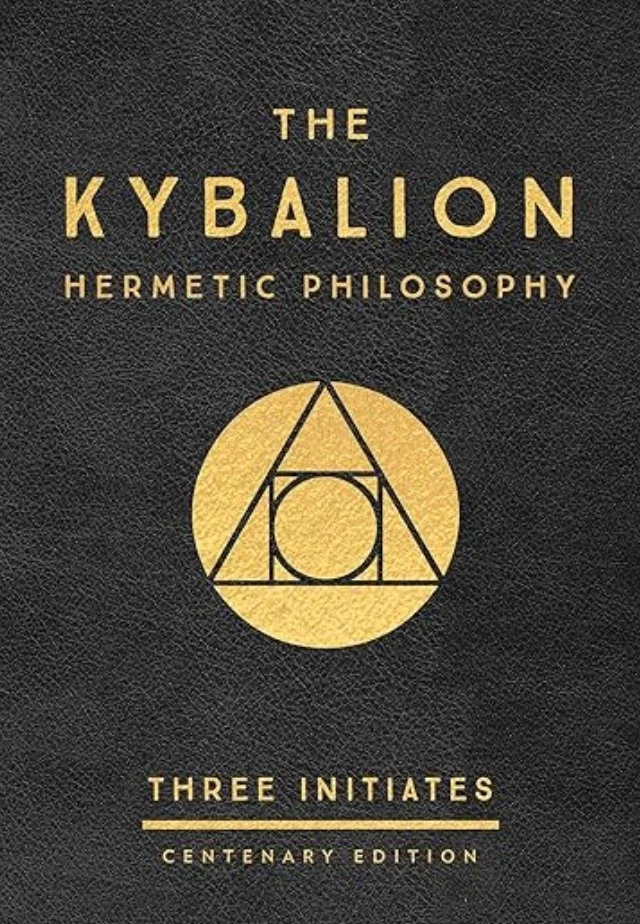
Can I go even further into the fabric of spacetime? Why not. In 1908, the Yogi Publication Society in Chicago published The Kybalion by Three Initiates. The book's origins “have mystified many, and it has been a central text in occultism and spirituality.” In its introduction, I find that the book contains "closely guarded fragments of the Hermetic Teachings which have come down to us over tens of centuries which have elapsed since the lifetime of its great founder, Hermes Trismegistus (Thrice-Greatest Hermest), a legendary, semidivine figure, the 'scribe of the gods,' who dwelt in old Egypt in the days when the present race of man was in its infancy." Hermes Trismegistus is often identified with both the Greek god Hermes and the Egyptian god Thoth.
There are seven Hermetic principles covered in the Kybalion, and number four is:
The Principle of Polarity
"Everything is Dual; everything has its poles; everything has its pair of opposites; like and unlike are the same; opposites are identical in nature, but different in degree; extremes meet; all truths are but half-truths; all paradoxes may be reconciled."
Thesis and antithesis are identical in nature, but different in degree. Another example is heat and cold. There is no point when heat changes to cold - it is the same thing, but at a different degree. So is love and hate. And here this truly ancient knowledge connects with the present-day Emotion Code. When we encounter a trapped emotion, for example, anxiety, while we hold the intention to release it, we can also hold the intention that, through a process the Kybalion calls "Mental Transmutation," anxiety becomes its opposite: trust. Humiliation transmutes into dignity, failure into success, and so on.
The fabric of time is truly thin if we pay attention. Lastly, what connects Ayurveda, the Emotion Code and the Kybalion? Intention. It is the common denominator and key factor in Deepak Chopra, MD's 1989 book, Quantum Healing. Exploring the Frontiers of Mind/Body Medicine. It is all about the intention. Whether working with someone or holding a self-directed intention. When we say "I am releasing this trapped emotion," there is no doubt that this negative energy is gone - even better, transmuted into its opposite. Hate becomes love, conflict turns into harmony. How cool is that!