What are thoughts, and where do they come from?
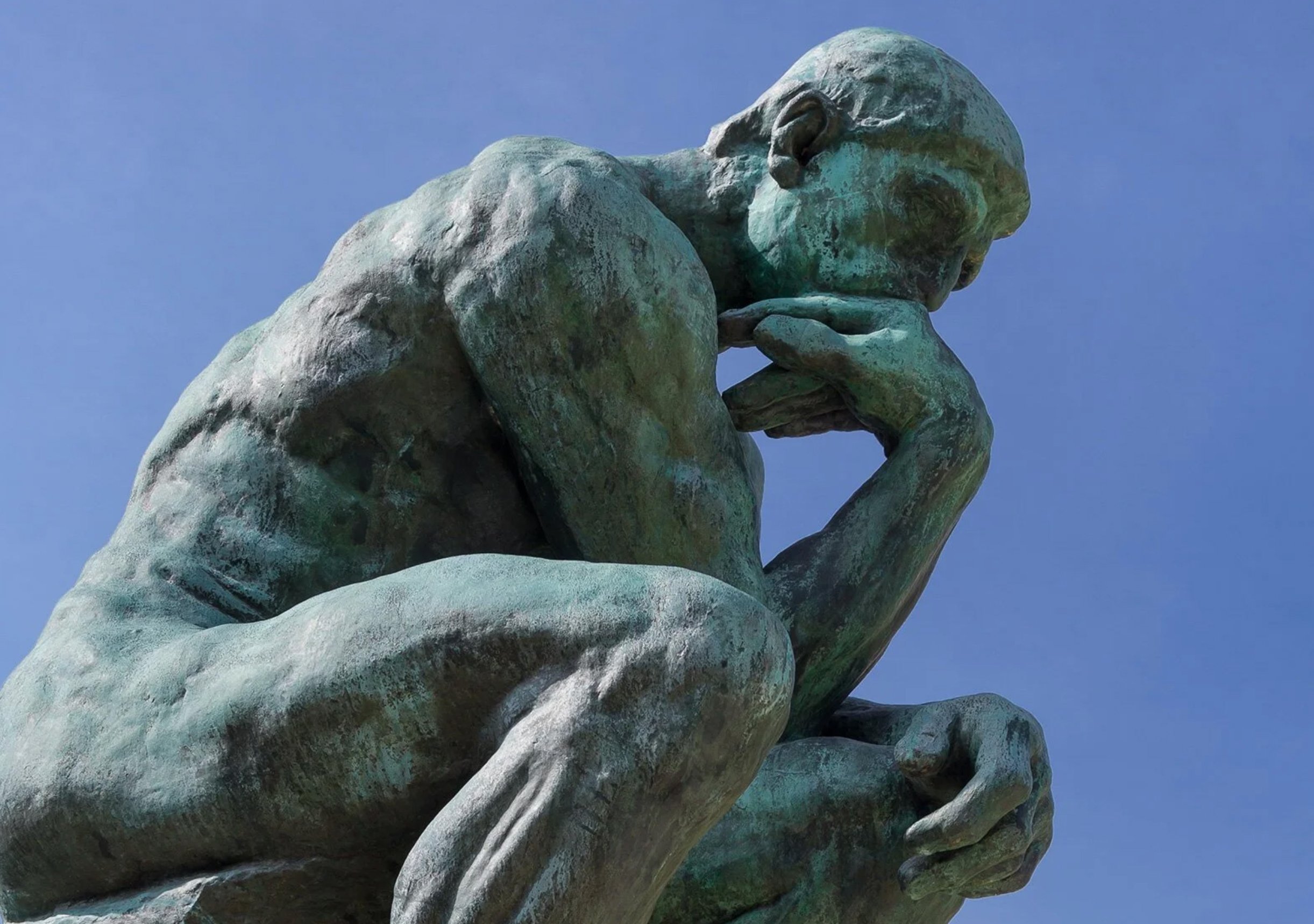
The Thinker (Le Penseur) by Auguste Rodin. Photo by: Douglas O'Brien.
In 1637, René Descartes, the French philosopher and mathematician, wrote in his Discourse on the Method, "cogito, ergo sum" - I think, therefore I am. The idea was that if you are doubting, wondering, or thinking at all, then there must be an "I" that exists to do that thinking. I suppose you can state the opposite - I am, therefore I think. Regardless of how it is presented, there is a lot to say about thinking, or not thinking, for that matter. According to the SFMoMA website, Joseph Beuys, a German artist and art theorist, said, "One of the most important statements of the enlarged understanding of art is that already the thought is a sculptural process. The thinking process is a sculptural process." The year was 1971. He was ahead of his time. Now, there is a way to photograph thought tracks in 3D using a process called PET (positron emission tomography). By injecting glucose tagged with radioisotopes into the blood, one can observe as the markers move through the brain, essentially creating a three-dimensional representation for every thought, creating a thinking sculpture. If the imaging is extended to the whole body, the result would be even more provocative. The whole body would represent what we are thinking—an alchemy, so to speak. Starting with a non-material domain (a thought) and ending with a material outcome - a neurotransmitter released into the bloodstream (as a result of having a thought) that changes the body's response.
The mainstream view generally treats thoughts as emerging from neural networks that interact in real time, with prior experience and the present context influencing what arises. Even spontaneous thoughts are often linked to memory traces and emotional cues, not just random free-floating ideas. However, the exact origin of a thought is still partly mysterious. Some argue that thoughts come from a collective mind, a shared field of consciousness, or something beyond the brain. Like little information bubbles floating around. Once presented to the mind for consideration, there is an option to engage, which, in most cases, leads to another thought and another in the never-ending spiral. Or, to ignore it. Dismiss it… and the thought will float away. Still, it's worth considering that every invention, every breakthrough, every idea for something originated as a thought. Some say that we create the reality around us. In a way, it is true.
According to Dr. Joe Dispenza, a chiropractor, author, and lecturer known for his teachings on the mind-body connection, epigenetics, and neuroplasticity, thoughts come first, followed by emotion -a thought or intention sends the signal, and the feeling follows as the response. In other words, thought creates the signal while emotion amplifies it. Since it is pretty hard not to engage with the thinking process, the whole body is constantly changing. If we agree with this view, engaging with negative thoughts could elevate the body's stress response or, conversely, promote homeostasis, allowing the body's self-healing properties to work their magic by selecting positive thoughts. But that is not the real answer - thoughts are just thoughts. They come and go. It is the perception that makes the difference. The way we notice, interpret, and make sense of information. It is not just seeing or hearing something, but understanding what it means. This is influenced by all the programs and beliefs acting as filters through which we perceive reality. By letting go of negative beliefs—the Belief Code can help with this—our perception changes.
"The underlying concept is that the body knows how to maintain balance unless thrown off by disease; therfore, if one wants to restore the body's own healing ability, everything should be done to bring it back to balance. It is a very simple notion that has profound consequences."
~ Deepak Chopra, MD, Quantum Healing. Exploring the Frontiers of the Mind/Body Medicine.
It comes down to the fact that we are the medicine. Everything is already on board. A new approach emerges, or rather very old one is rediscovered - one in which, mind, consciousness, meaning and above all, the intelligence of every cell in the human body play a key role in this constantly changing energy field which we call the human body. Nothing stands still. Beuys may be right comparing a thought to a sculpture, but he misses the fact that it's a living sculpture, constantly changing. It is more like a river that continually alters its composition. Changing one element changes the whole. That is why the holistic approach to health, so well known in antiquity, is coming back to us. All three modalities I work with—the Emotion Code, the Body Code, the Belief Code—share a holistic approach, which explains their effectiveness.
“The material body is a river of atoms, the mind is a river of thought, and what holds them together is a river of intelligence.”
~ Deepak Chopra, MD, Quantum Healing. Exploring the Frontiers of the Mind/Body Medicine.
For the top image, I decided to use Auguste Rodin's The Thinker. Interestingly, Rodin desired to use the whole body, not just the face in concentration, to show thinking as a full-body experience. The Thinker was not originally intended as a standalone sculpture. Rodin first designed it as part of The Gates of Hell, a much larger work inspired by Dante's Inferno. In fact, Rodin first created the figure as Dante himself, titled The Poet. The sculpture's power comes from Rodin leaving the meaning open enough for multiple interpretations, allowing people to project their own anxieties and ideas onto it. That ambiguity is part of why it became such an icon rather than just a scene from a larger work. What is The Thinker thinking about? The human condition, the act of creation, his own damned soul, the Inferno? Or nothing in particular... perhaps Rodin captured a rare moment when the mind enjoys a brief freedom from thought. What do you think?