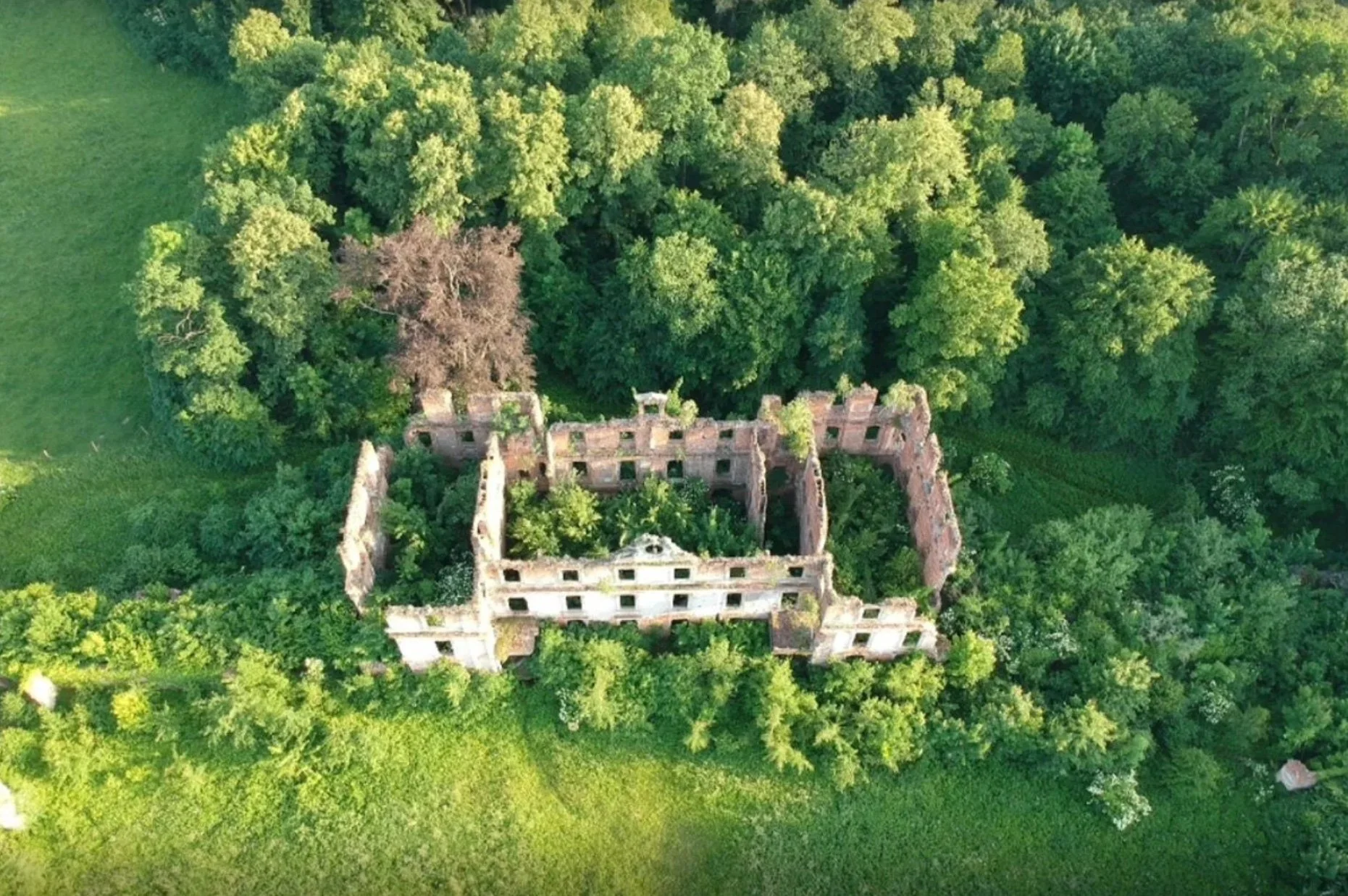
What is left today from the magnificent Słobity Palace in North-Eastern Poland. Photo by Fools Riders, 2019
In simple terms, interior architecture sits between architecture and interior design - it shapes a building's interior structure, not merely its decoration. I hold a Master's degree in interior architecture. The diploma itself is a handsome object—more like a passport than something you'd frame and hang on a wall. Bound in faux red leather with a gold eagle stamped on the cover, it lives in the bottom drawer of my desk, among other bits and bobs. Over the years, I did only a couple of gigs as an architect, yet architecture was always present in my life—more a theme, a quiet attraction, than an everyday profession.
There is a moment from 1987 that I remember vividly. I am standing with my dear friend Kasia in front of a wall plastered with many panels of our Master's project. We had decided to work as a team, which was unusual at the time. For our thesis, we chose an abandoned, ruined palace in Słobity, Poland, together with its vast, barely visible park and formal garden. Instead of walls, floors, and a roof, we worked with trees, shrubs, and lawns. The open sky was our ceiling, and the passage of the seasons organized the ever-changing lighting of the space.
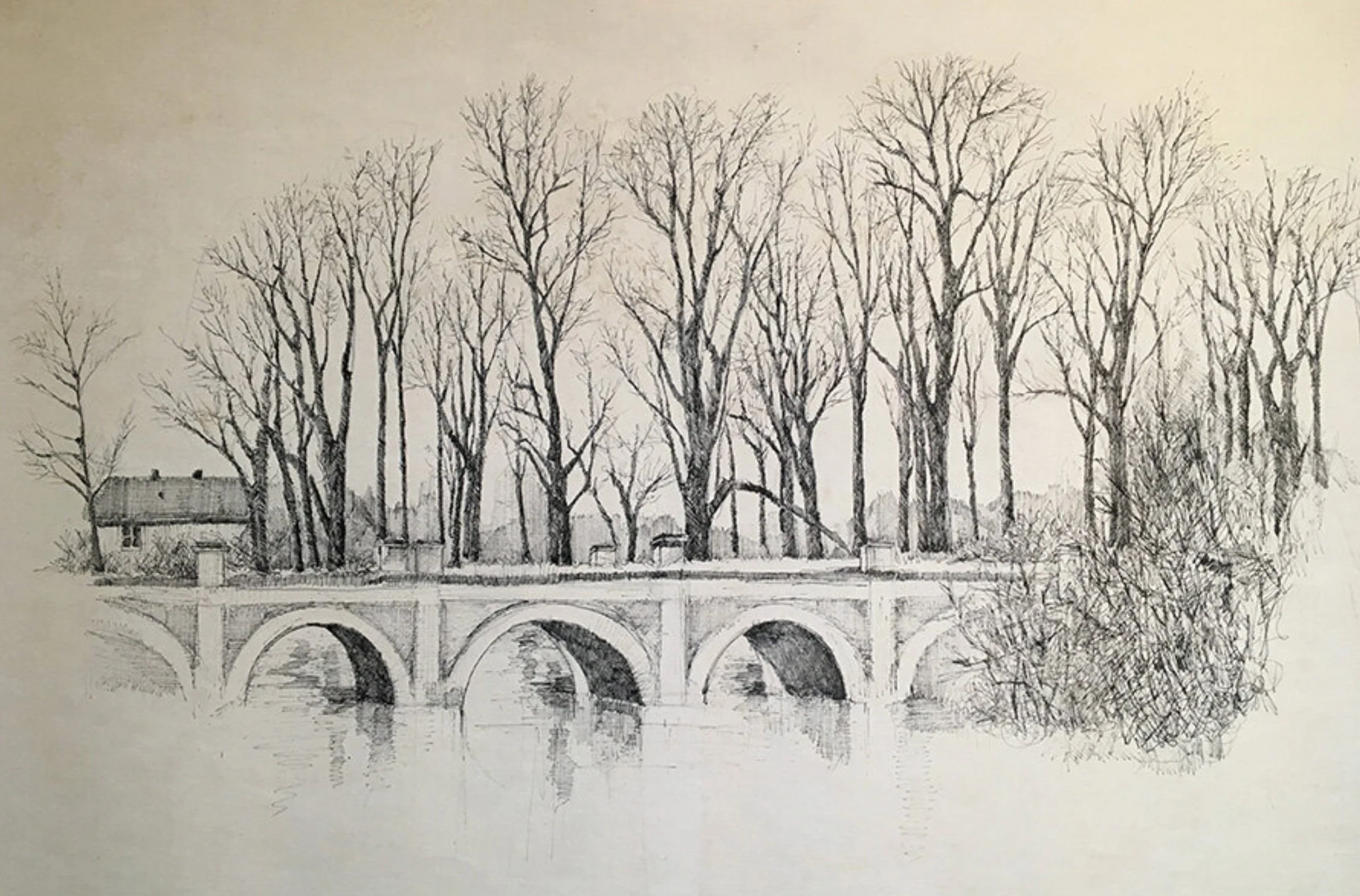
A bridge leading to the palace in Słobity, drawn by Gregory Ronczewski, 1986.
Słobity was a fascinating site. Napoleon visited it, as did Wilhelm II, the last German Emperor and King of Prussia. Until 1945, when the Red Army plundered and burned the palace, it housed the largest private library in Europe—over 55,000 titles—and was the most significant Baroque palace ever built in Eastern Prussia. For several months, we had to master skills that had little to do with interior architecture. There was a great deal of landscape archaeology: looking from a distance at a relatively young forest, trying to recognize in the rhythm of a few old trees the line of a long-forgotten main road. For our virtual reconstruction of the park, we had to learn the natural cycles of trees and shrubs and how they coexist to propose rich, sustainable vegetation that would take decades to mature. Something powerful in that forgotten place gave us the strength to learn everything we could about its history.
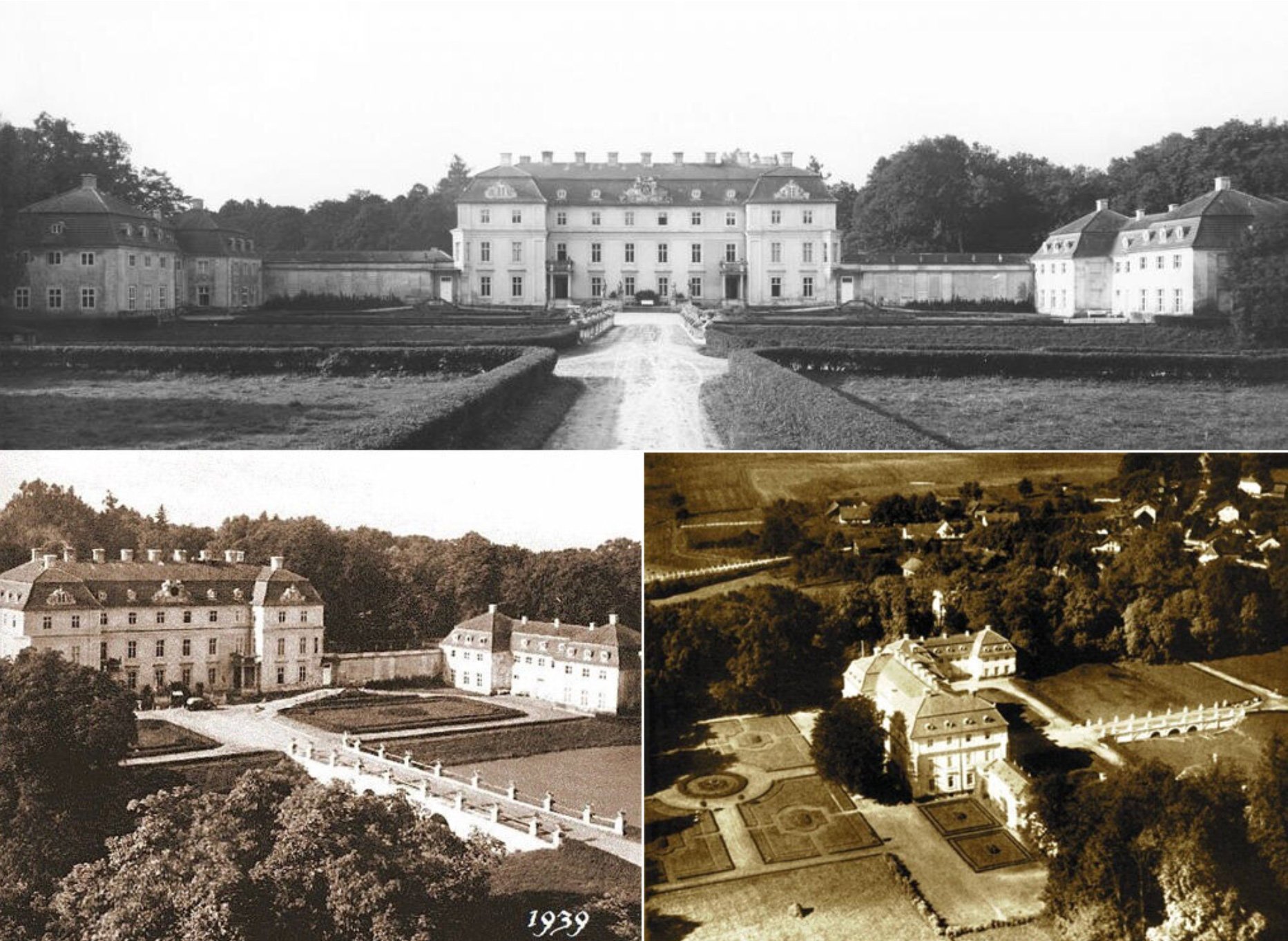
Słobity before 1939.
Years later, I discovered that our approach had a name—or rather, that someone had finally given a name to what we had intuited. Gilles Clément, professor emeritus at the École Nationale Supérieure de Paysage in Versailles, defines the Third Landscape in his manifesto (Manifiesto del Tercer paisaje, 2004) as "the sum of the space left over by man to landscape evolution – to nature alone." He explains: "Compared to the territories submitted to the control and exploitation by man, the Third Landscape forms a privileged area of receptivity to biological diversity. The variety of species in a field, cultivated land, or managed forest is low in comparison to that of a neighbouring unattended space." From Clément's perspective, a place that belongs neither to light nor to shadow is not governed by the rules that apply to the other two.
"Watching wasteland, I am not only fascinated by the energy of nature's reclamation, but I also want to know how to insert myself in the midst of this powerful flow."
~ Gilles Clément
The Third Landscape consists of the spaces man has surrendered to nature: forgotten urban and rural places, transit corridors, industrial wastelands, swamps, moors, and bogs, as well as the edges of roads, rivers, and train tracks. Our Master's project was, in fact, a Third Landscape—conceived before Clément wrote his manifesto.
Clément is perhaps best known for his concept of the Planetary Garden. Compare the garden with the landscape: the garden is what you design, in all its details and plans. The landscape is not. It is unpredictable, governed by natural forces. The very etymology of garden points to enclosure—an area protected and controlled.
The more control we have, the less diversity we allow.
The dynamics of an abandoned space are far richer than those of a space used exactly as planned. There is something magnetic about these empty places—places that are no longer and not yet. All that remains is a thought, a possibility, a dream: a space open to opportunity. It is no accident that so many film directors choose an abandoned warehouse or factory for their climactic scenes — think of Japan's deserted Hashima, the "ghost island" where part of Skyfall was filmed. A similar energy brought us to Słobity, an undefined possibility.
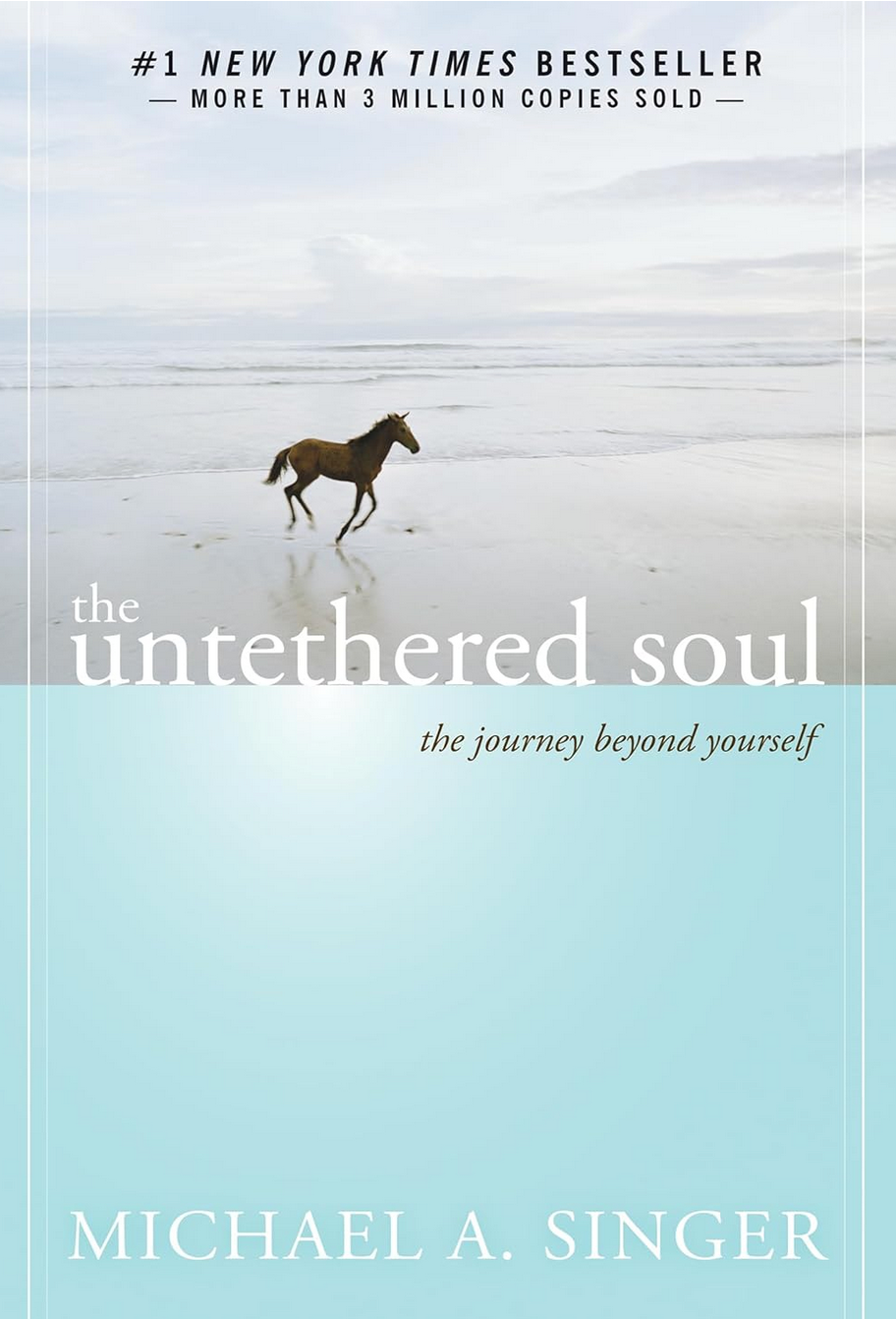
A truly wonderful book, and he wrote a sequel worth reading, Living Untethered: Beyond the Human Predicament.
In his bestseller, The Untethered Soul, Michael A. Singer describes how our minds quietly build an inner house made of thoughts, emotions, beliefs, and past experiences. This house is not something that happened to us - it is something we designed. Each of us carries within an interior architect—tireless, meticulous, and almost entirely unsupervised—who has been drafting blueprints since childhood. Every painful experience becomes a load-bearing wall. Every fear gets framed as a hallway we learn to avoid. Every cherished opinion is mortared into place as if the structure would collapse without it. The architect's brief was simple: keep the inhabitant comfortable and safe, keep the weather out. And it succeeded so completely that we forgot we were ever the client. We came to believe the floor plan was reality itself—that the view from our one small window was the whole sky.
"We shape our buildings, and afterwards, our buildings shape us."
~ Winston Churchill, the House of Commons, October 28, 1943
But the same architect who built the walls knows exactly where the seams are—a quiet hope in Singer's metaphor—a structure that was designed can be redesigned. The inner architect doesn't have to keep reinforcing old walls with fresh rumination every time a memory rattles the windows. It can begin a different kind of project—removing a wall here, widening a doorway there, letting the house become less fortress imprisoning you and more pavilion, open on all sides to the field of possibilities it was always standing on. The work isn't demolition by force. It is the slow, deliberate craft of noticing which walls were built from fear rather than need, and choosing, one by one, not to repair them.
"Let me tell you one thing. In the world we live in, 98% of what gets built and designed today is pure shit."
~ Frank Gehry, Canadian and American architect and designer
In the end, the finest thing our interior architect can design is not a more beautiful house, but the willingness to live without one. Letting go of trapped emotions, negative programs, and limiting beliefs is a step toward an inner space of unlimited potential—a wild, unattended landscape of the soul. A space that belongs to the other 2% of Gehry's quote.