Allergies and Intolerances: What’s the difference

Meet Murphy, one of the cats that spends time with us. I am not sure why, but for some reason, many cats from the neighbourhood love to hang out in our garden, and I enjoy their company so much. Ten years ago, I would not have dared to even think about something like that.
Allergies are among the most common chronic health conditions in both the United States and the EU, affecting roughly one‑third of adults and more than one‑fourth of children in the U.S. This means that well over 100 million people have some form of allergy. Across Europe, population‑based studies suggest that up to about 30–40% of people show some sensitivity to at least one common allergen, and hay fever alone affects roughly 10–30% of the population in many EU countries.
The most common allergies fall into three broad categories: food, respiratory (seasonal and indoor), and skin‑related. In food, milk, egg, peanut, tree nuts, shellfish, fish, wheat, soy, and, increasingly, sesame account for the vast majority of allergic reactions, with cow's milk and egg being especially common in infants and young children. For respiratory allergies, pollen from trees, grasses, and weeds causes hay fever in millions. At the same time, indoor allergens such as house dust mites, mould spores, and pet dander are major triggers of asthma. Skin‑related allergies include heavy metals, cosmetics, or chemicals, while eczema often co‑occurs with other allergic conditions.
"Seasons change, the world blooms bright,
yet my body mourns what others greet with delight."
Standard allergy therapy starts with allergen avoidance: identifying triggers via testing or common sense, and then minimizing exposure, using air filters, avoiding specific foods, or limiting contact with pets. Medications such as antihistamines, nasal corticosteroid sprays, eye drops, and bronchodilators are used to control symptoms of hay fever or asthma.
Welcome to my world. Or, rather, a world that I used to live in. Ever since I was a kid, the word "allergy" has been present in my life. I was always sick, and a few times ended up with a full-scale pneumonia, grounding me for weeks. When I was about 14, I was tested for allergens, with the results confirming what we already knew—cats and dogs were on the list, along with house dust and some pollen. The testing, as I recall, aligned with my family moving to a new apartment. Things got better after the move, partly because the new place was... well, new, not much dust and no pets. Was I cured? No, not at all. Visiting family or friends who happened to own a cat or a dog was off the list. I could hardly stay for an hour or so before my breathing would change, and my eyes would fill with water. So, I learned to avoid cats and dogs, as well as dusty attics or basements.
Fast forward to 2005, when we bought a house on Bowen Island. I did not expect that the Red Alder, along with Hemlock, would render part of each February and early March so miserable. Every year, for at least two weeks, I was out of commission, sneezing, coughing, and feeling awful - until I wasn't. What happened? The trees are still there, neighbour cats are coming for a visit every day, and I enjoy their company as much as I can, making up for all the years I could not touch them.
Here is how Allergies are described in the Body Code: Physical allergies are generally created when the subconscious mind makes a faulty connection with a particular substance during either prolonged or sudden emotional and/or physical stress. This substance is then considered an allergen by the subconscious and the body, and a negative response or reaction will occur when it is encountered in the future.
The subconscious mind may create a physical allergy as a protective measure to defend you from the stress that it has connected with the allergen. For this reason, you can become allergic to pretty much anything.
Symptoms may include physical reactions of all kinds, as well as immune reactions such as inflammation, respiratory problems, congestion, sinus irritation, itchy eyes, and other forms of hypersensitivity.
Physical allergies nearly always have associated imbalances, such as trapped emotions, that must be cleared to reset the subconscious response to the allergen.
It is common to have both a physical allergy and an "idea allergy" to the same allergen.
So, was I cured by releasing a bunch of trapped emotions? Yes, finding negative associations with past events was critical. But apart from regular sessions, I changed my diet, drastically reducing sugar, processed food, white flour, and animal-based products. Changing my diet was a gradual process which took over 2 years, and now I do not eat any animal-based products. Also, I started applying Wim Hof methods, including breathwork and cold exposure. Initially, ending each morning shower with a minute or so under the cold water. Later, I swam in the ocean all year long - here is the post titled December Swim. And the allergies? Gone, nothing, zero. However, last year I felt that something was coming my way - not an allergy but perhaps some intolerance.
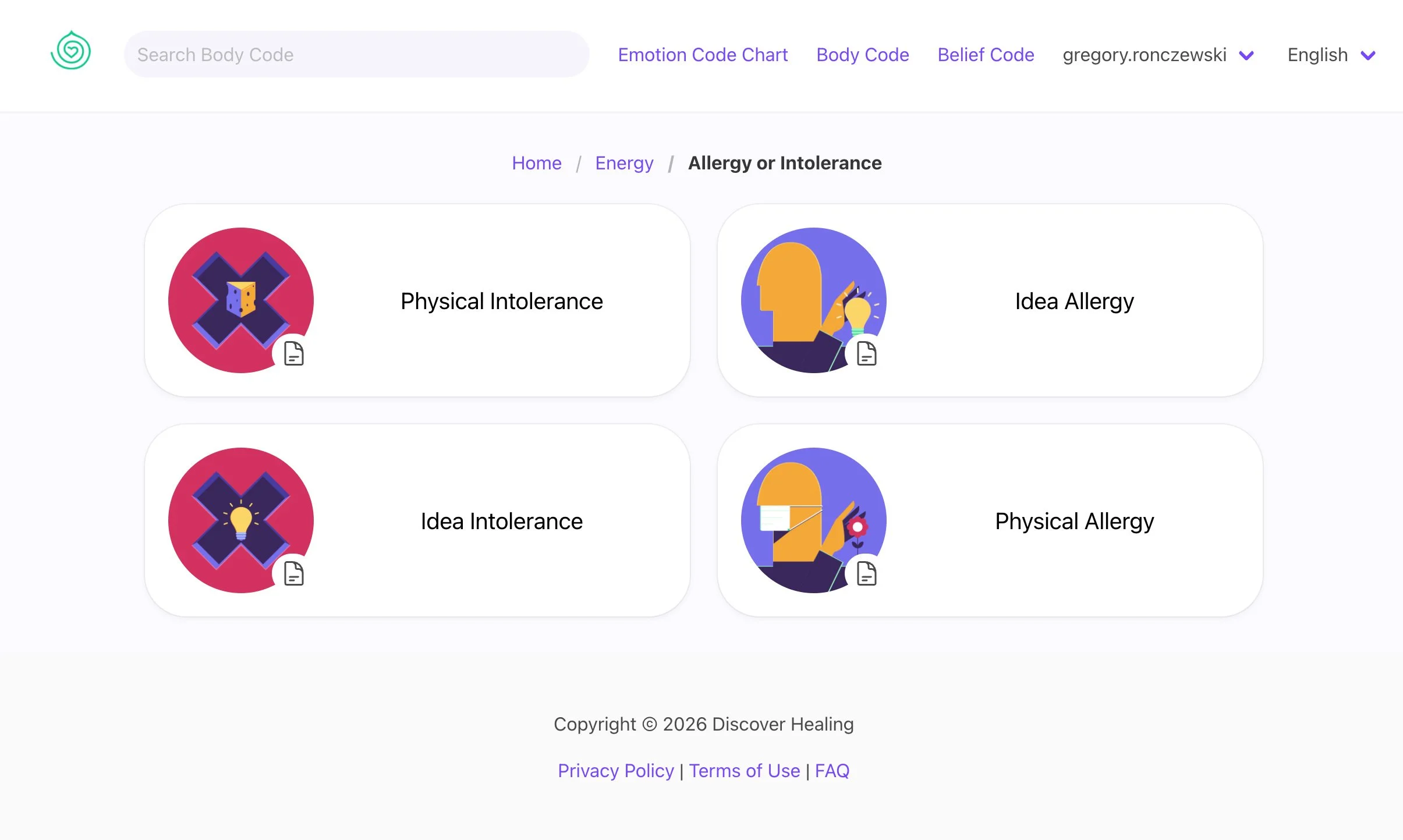
A screen grab from the Body Code App.
In the Body Code, there is a separate entry for Physical Intolerance: Physical intolerances may manifest when the body comes into contact with a substance it has trouble processing, usually because the body is already imbalanced or stressed and therefore less able to digest or otherwise process it.
It is possible to have an intolerance to anything, but most commonly, intolerances are from foods and drinks, as well as cosmetics such as lotions and perfumes.
The subconscious mind manifests the symptoms of physical intolerance as a way to communicate that the body is imbalanced and needs help.
Symptoms may include fatigue, extreme or sudden sleepiness, headaches, skin issues, digestive discomfort and bloating.
In other words, my capacity to handle stress was exceeded, and by the end of February, I felt it was reaching its limit. Imagine the capacity as a bucket full of water, which represents the energy. When we fill the bucket with a bunch of stones (trapped emotions), the capacity will be significantly reduced. Releasing trapped emotions restores the capacity - a few sessions got the job done without involving any allergies. Anything can cause anything. By addressing the root cause, we can correct the faulty association with a substance or idea. The result is an allergy-free, happy life. However—and this is important—since in some cases an allergic reaction to an allergen can cause serious conditions, I would remain vigilant, not jumping right into a bowl of peanuts mixed with shellfish when you have been carrying an epinephrine injector for the last decade. Still, it is deeply gratifying to watch the typical allergic reality unfold into unexpected freedom.
Lastly, it is worth noting that in the Body Code, apart from Physical Allergies and Intolerances, we also have Idea Allergies and Idea Intolerances. Is it possible to become allergic to a concept or a thought? Yes, very much so. It happens when the subconscious mind makes a faulty or negative connection with a particular idea - a thought, emotion, concept, event, action, person, place or thing. Usually, this occurs during either prolonged or sudden emotional and/or physical stress. It explains why we sometimes feel sick in the stomach just at the thought of going to an event or meeting a certain person. Sounds familiar?