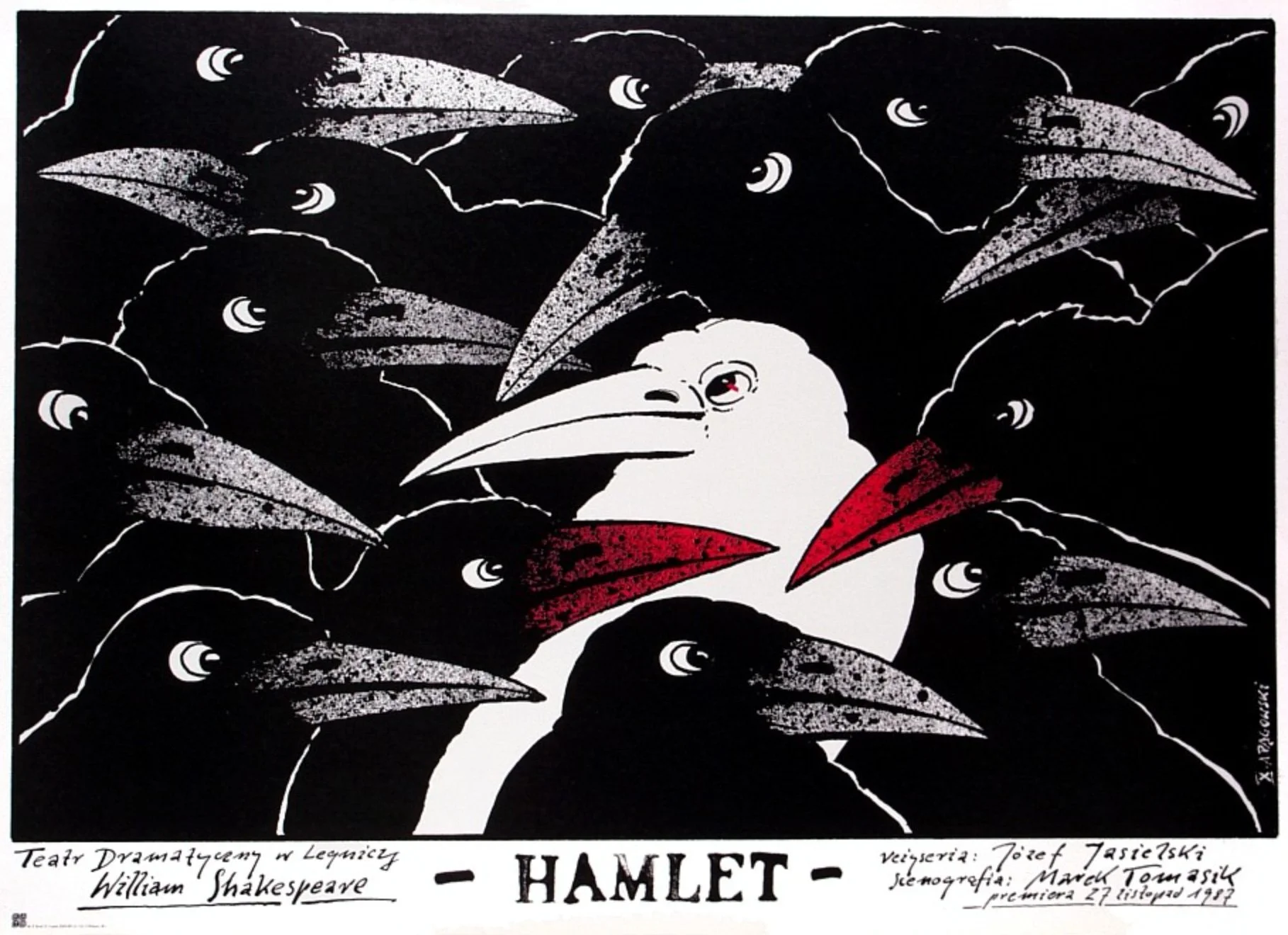
Theatre Poster: Hamlet, William Shakespeare. Design: Andrzej Pągowski, 1987
So much has been written about the Design Thinking Process - a human-centred, iterative approach to creative problem-solving that balances what is desirable for people, what is feasible with technology, and what is viable for business. Books, diagrams, flowcharts, and numerous videos address each step of the process. Interestingly, their authors focus on the Design aspect. What about the Thinking portion? What about it? Thinking is just thinking. Is it? We take it for granted - everyone does it, or at least that's what everyone believes. When I say, "I have been thinking," what does it mean? Where do thoughts come from? Does the mind generate them? Perhaps. However, there is an alternative view. What if thoughts belong to an energetic landscape and depend on a multitude of energy fields that surround us? It is the mental context, so to speak. The brain is just a receiver, tuned to a certain frequency, picking up thoughts, pre-filtering them and then presenting them for the mind to consider. It is similar to any other data gathered by our senses. Only a fraction of what is registered gets promoted to shine on stage for the mind to decide whether it is worth engaging. We would go insane if we saw everything our senses register.
Let's consider a single thought. The mind finds a thought. When you touch that thought floating in the mental landscape, it gains energy—your energy, because energy follows attention—and momentum, and the mind immediately begins developing a story around it. The story is made up of past experiences, ideas, additional thoughts, and emotions. From parents, schools, family, community, news and interactions with the environment - every story the mind touches forms and regulates our personalities. As Dr. Joe Dispenza said, personality is a personal reality. A desire, a magnetic pull, draws you into that expanded thought. Repeat this routine a few times, and it becomes a habit, and before we know it, you have formed a belief - a lens through which you interact with experience, or life. One of the first things taught in the Hermetic training—an ancient spiritual, philosophical, and esoteric tradition rooted in the writings attributed to Hermes Trismegistus—is not to engage with that initial thought. Create a distance between the mind (the observer) and the thought (the observed). When you step back, the story dissolves. Easier said than done. Thoughts are highly addictive, and our ego loves them. Being aware of the process lets us analyze it, and suddenly we gain insight into how and why our desires form.
So what? Now I understand the process. What difference does it make? Well, it makes a huge difference. Which stories I want to engage with, and which I do not? There is always a freedom of choice. A thought is an imagined potential. A potential that exists in the fabric of the unlimited field of consciousness. A belief, on the other hand, is an intent to collapse the infinite potential into reality. Every invention, every piece of machinery, art, or software originated as a single thought. Even a dinner recipe started as a thought. Put differently: we create our reality. Consciously or unconsciously. To understand the mechanics behind, Google quantum physics and the collapse of the wave function into a particle, Google quantum physics and the collapse of the wave function into a particle.
Once we observe our thoughts and our emotional investment in them, we become aware of the conditioning that makes us do certain things. We can choose to step out of the mental stream and do something different. We realize how social and environmental conditioning shapes our lives. Again, it is driven by our beliefs - the inner state and assumptions magnetize external reality. Because your imagination is God's creative power within us, whatever we truly consent to in consciousness must eventually express itself in our world. However, once we step out of the mental stream, we will feel the pressure, the magnetic pull to go back, to conform to the conditioning. Why? Because it is simpler and takes less energy. Because it is known. A group consciousness steers the boat, and I get a free ride on its energy, but am I happy with this? Is this how I want to live my life? There is always a choice.
"Dare to believe in the reality of your assumption and watch the world play its part relative to its fulfillment."
~ Neville Goddard
Neville Goddard, Vadim Zeland, or Florence Scovel Shinn, among others, point to the same idea: we are all creating our reality. Knowingly or unknowingly. The magical genie that Aladdin found in the lamp listens constantly to our thoughts, feels our emotions, et voilà - our reality is served. For some, the world will feel terrifying. For some, it will be a bliss, a magical place. There is no right or wrong. No good or bad. It simply is - a mirror reflecting our state of being. We need to pay attention, become aware of the process, and decide whether we wish to alter the course of the timeline we are on. Instead of desperately changing the mirror—our reality—we need to change ourselves.
"We but mirror the world. All the tendencies present in the outer world are to be found in the world of our body. If we could change ourselves, the tendencies in the world would also change as we change our nature, so the attitude of the world changes towards us. This is the divine mystery supreme. A wonderful thing it is and the source of our happiness. It is a constant miracle."
~ Mahatma Gandhi, 1913
Through The Emotion Code, Body Code, and Belief Code, we help balance our physical, emotional, and mental state. The physical is bound by time and space. The emotional is only bound by space - there are no expiry dates on emotions. If not processed correctly, the emotion stays lodged somewhere in the body, affecting energy flow. Finally, the mental is not bound by time or space - we can jump in a second from place to place, from the past to the present or to an imagined place in the future.
Releasing trapped emotions, and especially releasing belief systems, allows us to clear some of the lenses through which we see the world. As our energy level rises, our peripheral vision expands, and suddenly we notice new things - new opportunities and new people appear in our lives. Slowly, we awaken to what is, appreciating the connection and our place in the fabric of consciousness - the all there is. And it all starts with a single thought that we choose to grab or let go.