Following Intuition. Is it worth the risk?
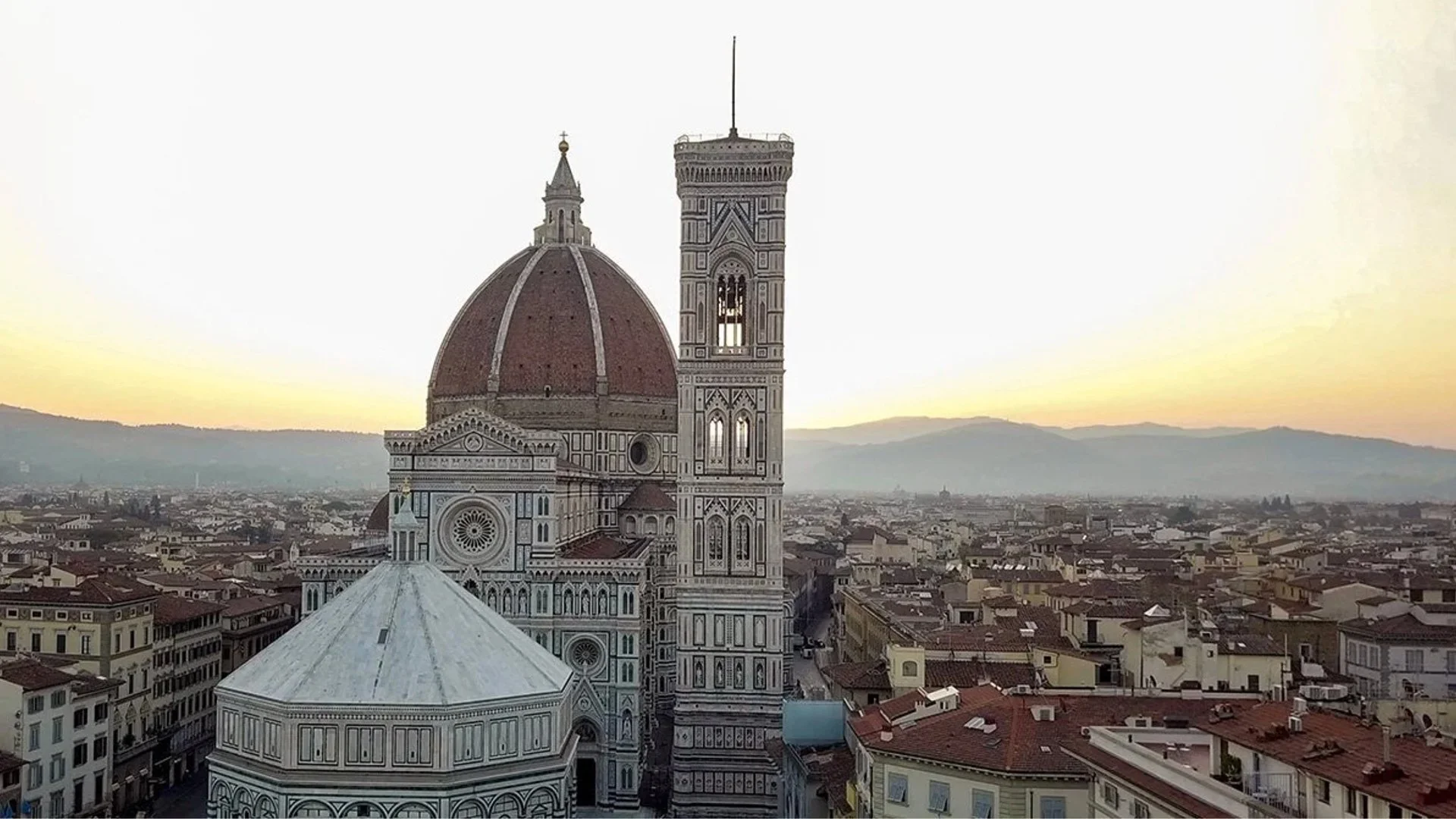
Santa Maria del Fiore Cathedral on the Piazza del Duomo along with Giotto's Campanile, Florence, Italy
In 1508, Pope Julius II appointed Michelangelo to repaint the Sistine Chapel ceiling. Why did he decide to offer this massive task to Michelangelo, who was a respected artist, but in a different field? At the time, Michelangelo Buonarroti was recognized only for his sculpture. He had done some small paintings; however, nothing of this scale. Not to mention, he had no experience with frescoes. Why then? Eric Weiner, in his excellent book The Geography of Genius, takes us around the world in search of the magic ingredient without which advances in science or art were not possible. Florence during the Renaissance was an extraordinary place, and Michelangelo was part of it along with Botticelli, Donatello, Gianbologna, and, of course, Leonardo da Vinci. So many incredible talents to choose from, and yet, the Pope gives the Sistine Chapel commission to a sculptor. Weiner explains that Julius II followed the Medici philosophy of patronage, which meant taking risks. It was about choosing someone who is obviously talented and then assigning an impossible task, especially if it seems like a bad fit. It was a gamble. Michelangelo accepted, though he was afraid he was set up to fail. So he had to prove otherwise.
"Without having seen the Sistine Chapel, one can form no appreciable idea of what one man is capable of achieving."
~ Johann Wolfgang Goethe, 23 August 1787
There is another interesting twist in the Florentine Renaissance that Weiner brings up. This time, he takes us back to 1401, a year that was not great for Florence. The city was under a siege from the Milanese army, and if this was not enough, the bubonic plague left only half of its population alive. The city council decided that they needed to do something about it. One would think in terms of inventing a cure for the plague or immediately engaging in peace negotiations. Well, they did something very different. An RFP was issued seeking proposals to fabricate a set of bronze doors for the baptistery of the city's most renowned church, Santa Maria del Fiore. The successful entry would receive a hefty commission and the admiration of the masses.
The competition was fierce, with only two finalists emerging: Lorenzo Ghiberti and Filippo Brunelleschi. The judges were split right down the middle. They could not decide. So they offered both men an option to work together on this project. Brunelleschi declined. He would work alone or not at all. So the contract went to Ghiberti.
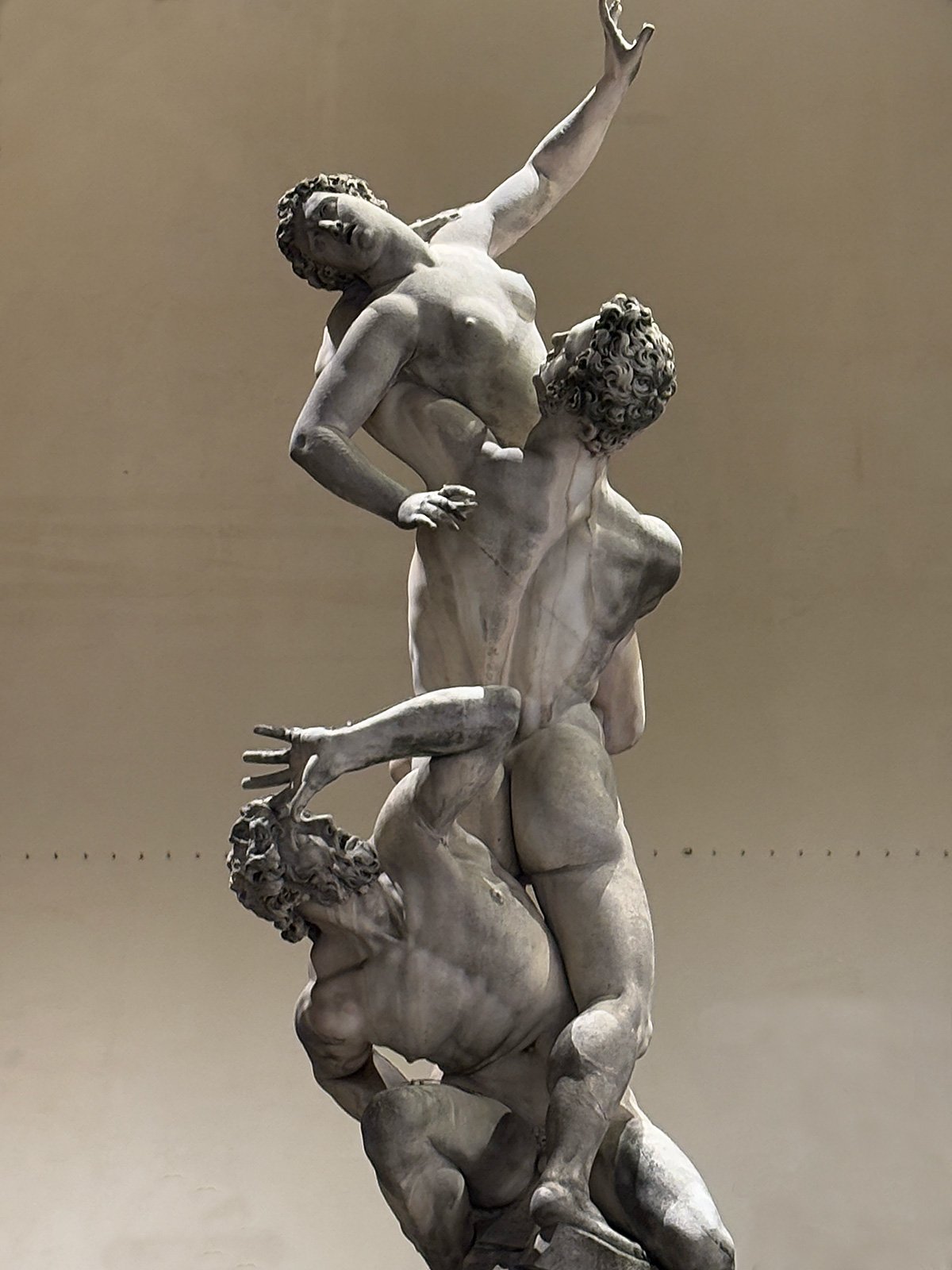
Piazza della Signoria, Rape of the Sabine Women, Giambologna,1583. Photo: Gregory Ronczewski
Not discouraged, Brunelleschi decided to try something else. Architecture was his secret passion—he was a trained goldsmith, and a pretty good one—and after studying ancient ruins in Rome, especially the Pantheon, he proposed to the Florence council his own project—the dome to cover Santa Maria del Fiore's transept—an unimaginable task at the time. No dome of that size had been built since ancient Rome. "I propose to build for eternity," said Brunelleschi. His Duomo is now the most recognizable symbol of Florence—a masterpiece admired worldwide. As for Ghiberti, he spent 25 years on the door project.
So we had an impossible task, a career change, and the refusal of a lucrative contract that led to remarkable results, still inspiring countless. "The rule of unintended consequences," Eric Weiner calls it. Brunelleschi was buried in Santa Maria del Fiore. The highest honour Florence has to offer to its children. He rests in peace under the largest brick dome in the world.
“Insight is not a lightbulb that goes off inside our heads. It is a flickering candle that can easily be snuffed out.”
~ Malcolm Gladwell, Blink: The Power of Thinking Without Thinking
So much is now spent to ensure risks are minimal. Any chance is considered dangerous. We have software, statistics, spreadsheets and tables - all to weed out any possible misfit or miscalculation. Are we missing something? We want a perfect fit, but then, once we have it, there is no tension. According to Weiner, environments that are less than ideal foster independent, divergent thinking, which is critical to innovation. The well-known moment when you leave your comfort zone and are pushed to find ways to solve your challenge. I am not saying that we should all change professions and start something new. I am sure we all have predispositions to master specific skills—a talent of sorts. Sometimes, though, the foundation skills of one discipline are also part of a very different field, making a good candidate in an unexpected domain. It's all about following passion. I have followed mine into the art of energy healing.
Lastly, assuming that nothing happens by chance (see Bell's Theorem), each challenge, each obstacle, or what one considers a disaster has a lesson embedded in the experience. Brunelleschi, by declining the lucrative commission, opened a path for a project that still amazes. He followed his passion. Often, with time, looking back, the path is clearly visible. But when we are in the midst of the experience, trying to make sense of it, it is hard to see the big picture. I believe it is about trusting that there is someone, or something, bigger—a certainty that it is not what I have to do, but rather, who I need to be.
"From a little spark may burst a flame."
~ Dante Alighieri
Clients sometimes ask, "So, how many sessions do I need?" I don't know, but with each session, the energy field changes, and releasing negative energy creates a vacuum instantly filled with positive energy. Each released trapped emotion, each energetically corrected misalignment or imbalance, takes us higher on the healing path, and beyond every bend and corner, new vistas open up, and the veil of depression, frustration, anger and low self-esteem falls apart. All it takes is an open mind, a bit of trust and curiosity to see what is possible, even if it sounds unattainable. Like the dome to cover Santa Maria del Fiore's transept—an unimaginable task.