Bell's Theorem: nothing happens by chance
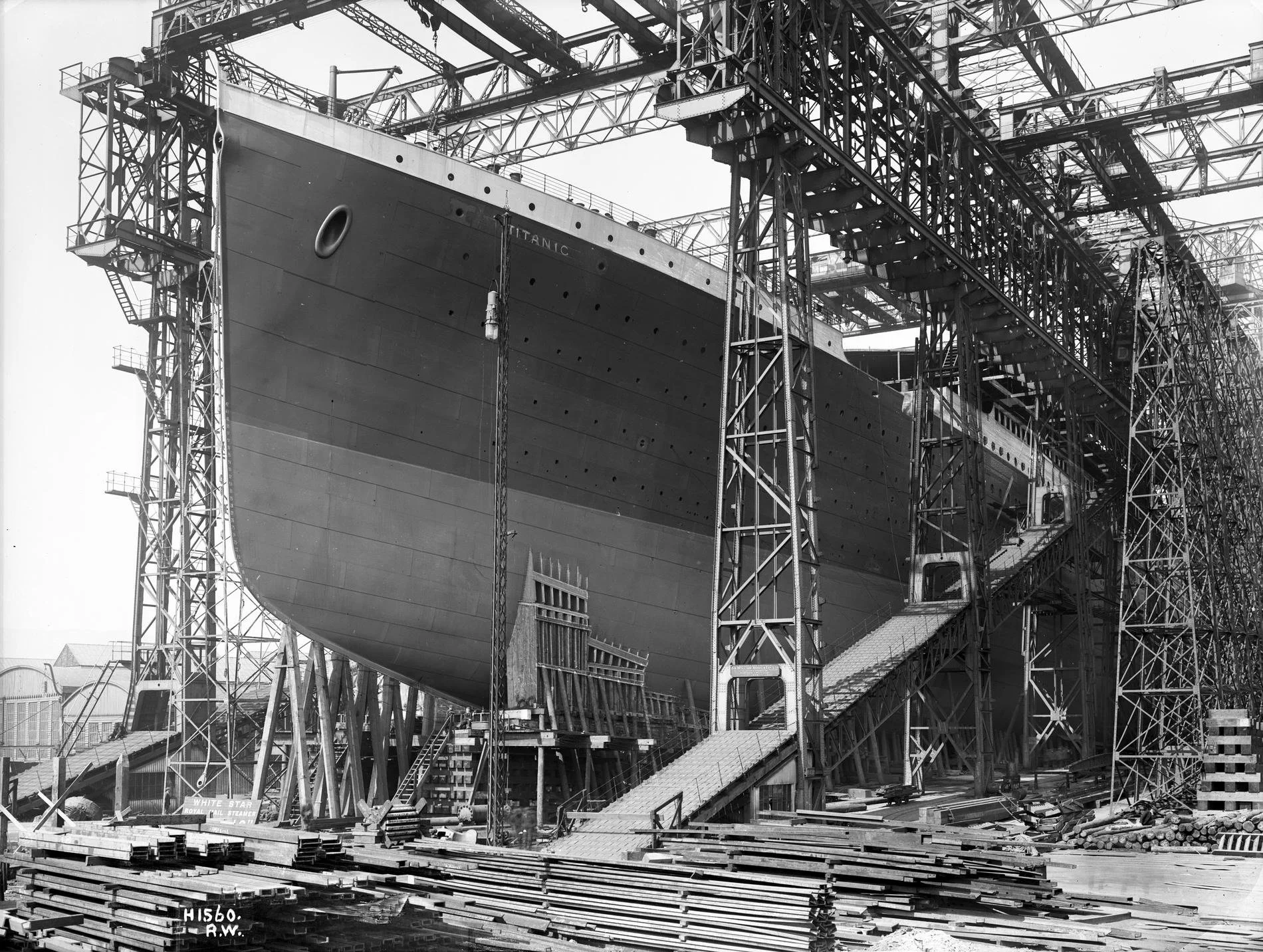
The Titanic ready for launch. The ship was constructed on Queen's Island, now known as the Titanic Quarter, in Belfast Harbour where was part of the Harland and Wolff shipyard. Photo: Robert Welch - This image is available from the United States Library of Congress's Prints and Photographs division under the digital ID cph.3a27541
1928, Belfast, Ireland. The city was still feeling the aftershocks of the political changes that led to the 1921 partition of Ireland. Its skyline dominated by the Harland and Wolff shipyard. The very same shipyard that built the Titanic. The Irish War of Independence left many scars that seven years later were still felt. Belfast was now the capital of Northern Ireland, but life was not easy.
John Steward Bell was born on July 28, 1928. His biographers note that from an early age, he was determined to become a scientist. Not only did he graduate from Belfast Technical High School, but he also received a bachelor's degree in experimental physics and, a year later, a bachelor's degree in mathematical physics from Queen's University of Belfast. He went on to complete a PhD in physics at the University of Birmingham in 1956, specializing in nuclear physics and quantum field theory. His determination to become a scientist created a catapult that propelled him to a position at CERN (European Council for Nuclear Research) in Geneva, which Bell took in 1960. Neither his parents nor his older siblings completed high school.
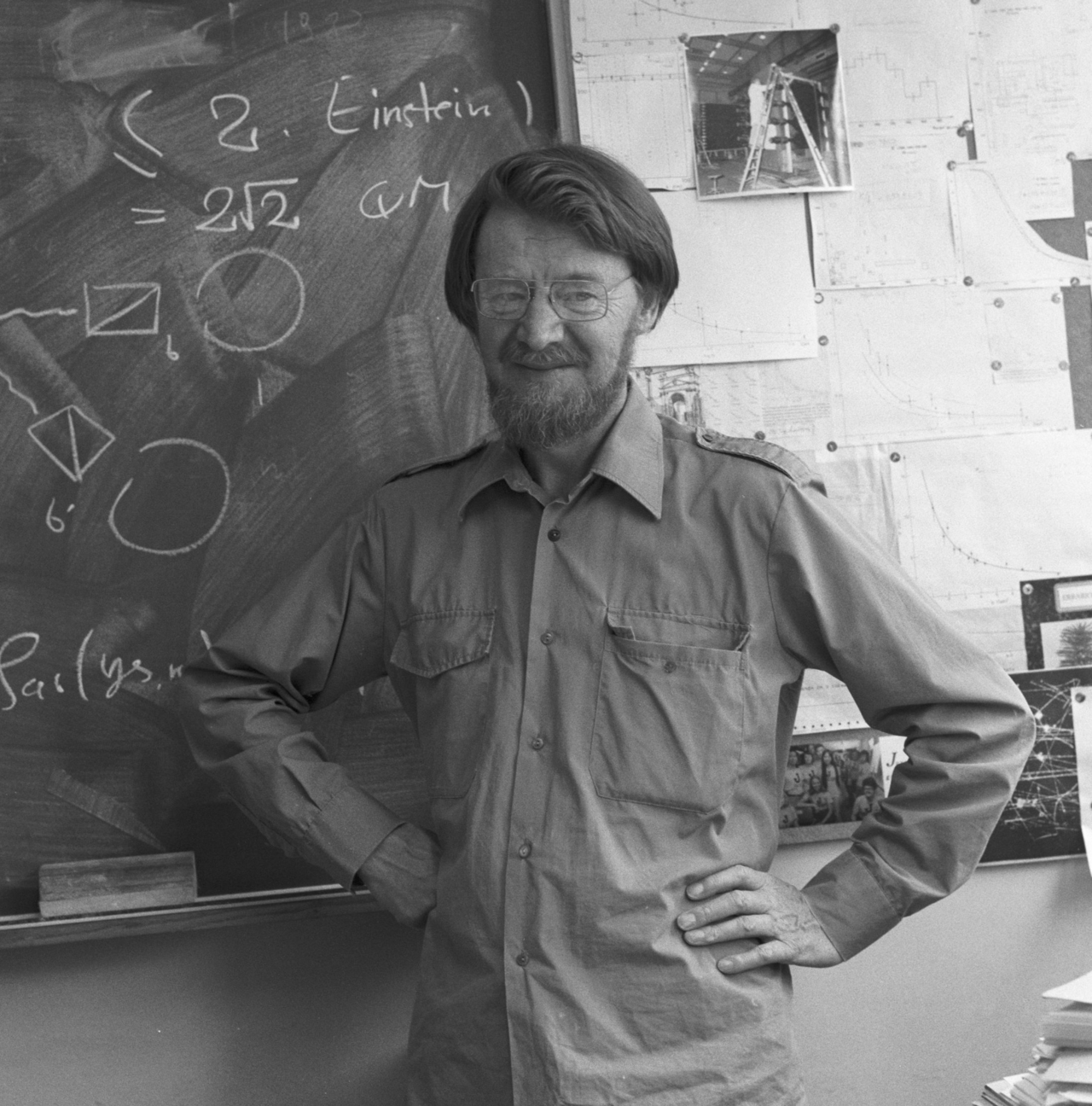
John Bell at CERN, June 1982
In 1964, Bell published a paper in the journal Physics, entitled "On the Einstein–Podolsky–Rosen paradox." EPR, for short, is the argument that if two particles can be perfectly linked or entangled across distance, then either quantum mechanics is incomplete or the universe doesn't obey our usual idea of locality. Quantum theory says entangled particles can share one joint state, so measuring one immediately changes what you can say about the pair as a whole. The key point is that this does not let you send usable information faster than light, but it does mean reality is stranger than everyday intuition suggests. Imagine a factory that makes two matching gloves and sends one glove to Vancouver and the other to Warsaw. If you open one box and find a left glove (a local action in Vancouver), you instantly know the other box (Warsaw) has a right glove. The EPR case is like that, except the particles are not just pre-matched in a normal way. Quantum theory says their properties may not be set until someone measures them (opens the box, and finds a left glove, or right, for that matter).
It was a paper that changed the view on how reality works. It came to be known as Bell's theorem. Henry Stapp, an American mathematician and physicist, wrote this about Bell's theorem:
"If one accepts the usual ideas about how information propagates through space and time, then Bell's theorem shows that the macroscopic responses cannot be independent of far-away causes. This problem is neither resolved nor alleviated by saying that the response is determined by pure chance. Bell's theorem proves precisely that the determination of macroscopic response must be nonchance."
A quote from The Dancing Wu Li Masters by Gary Zukav
Bell's theorem implies that a reaction occurring at a given time and place is not a matter of chance. Like everything else in the world, it depends on something happening elsewhere. Say it differently, everything is somehow connected. We are all connected. And this connectedness is arranged at a superluminal speed (faster than the speed of light) - at least, that's one possibility.
During a Body Code or a Belief Code Session, when I ask the client whether he/she is okay if I test for them, I feel an instant reaction, if not faster. When I started offering sessions, first to family members who lived thousands of kilometres away, I wasn't sure whether I was "projecting" a connection, or if my eagerness to make it work was pushing the pendulum (I was using a pendulum), but now I fully trust the subconscious mind. I can feel the connection, and I see the reactions, the wave of energy reaching the client and me at the same instance.
To send information—any information—we need a carrier: Canada Post, WiF, or any other medium will do. During an energy healing session, a lot of information changes place. There is no specific "provider" we practitioners use. We ask if it's okay to test or connect, and it works. But how?
One possibility was the ether - a 19th-century concept (actually much older, it goes back roughly 2,500–2,700 years, originating in ancient Greek thought) based on the fact that light needs something (a medium) to move through, like everything else, hence the idea that space was filled with an invisible substance that light needed to travel through, kind of like how air carries sound. In 1887, the Michelson-Morley experiment sought to detect Earth's motion through the ether by comparing light travelling in two perpendicular directions. If ether existed as expected, the speed of light should have looked slightly different depending on direction. But they found no such difference. So, no ether.
Still, what carries the information? And, it carries it in such a way that it moves through any matter, any material that stands in its path. A quantum field? From the perspective of the theory of relativity (Einstein 1905), light doesn't need a medium. Space itself doesn't have a preferred "still" frame. No matter if you're sitting still or cruising at constant speed in a spaceship, the rules of physics don't change for you. No "absolute rest" frame exists—everything is relative. Instead, space and time stretch and mix (spacetime) based on speed. When you move fast, distances shrink and time slows just enough so that everyone measures light at about 300,000 km/s. No ether required—it's a built-in law of the universe. But it doesn't explain how I can connect with my mother, who is 7,984 kilometres away (thanks, Google!). Does it matter? I mean, the lack of scientific proof, the formula, the definition. No, it does not. There are things beyond comprehension, and I am fine with that.
"The Tao that can be told is not the eternal Tao."
~ Tao Te Ching
John Stevard Bell died suddenly in 1990. That year, he was nominated for the Nobel Prize in Physics, but did not live to receive it. He was 62.