Being 27 again
This text was originally written for LinkedIn and published on February 26, 2026
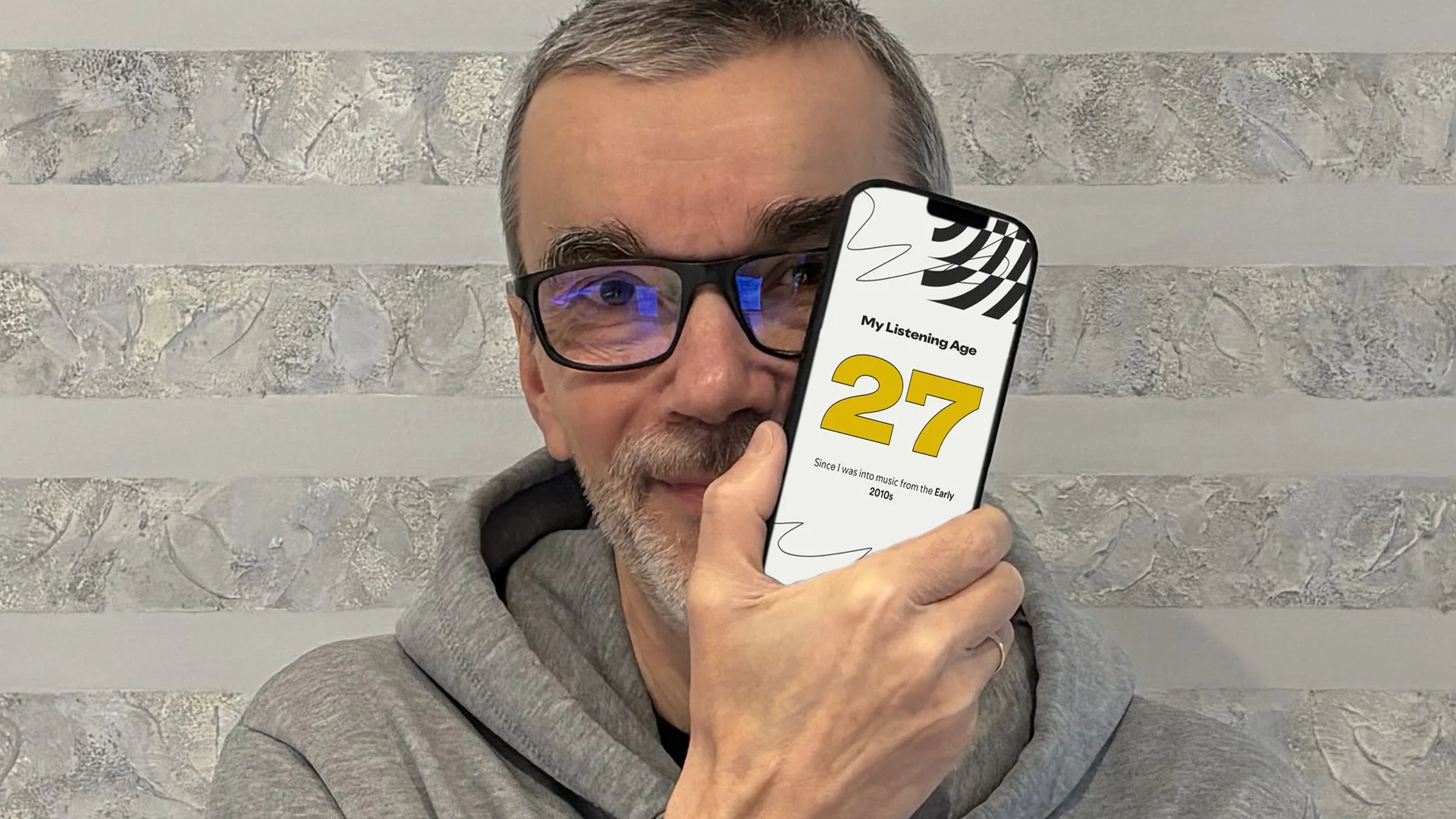
In early December, Spotify revealed the 2025 wrapper, and I got a little surprise. I was 27! Again, as it already appeared once on my calendar in 1989. I remember being glued to the small Russian TV set, watching in awe what unfolded some 500 kilometres away. The impossible becomes possible. People sitting atop the Berlin Wall, laughing and drinking beer, while the East German border guards, in disbelief, let columns of cars pass through Checkpoint Charlie.
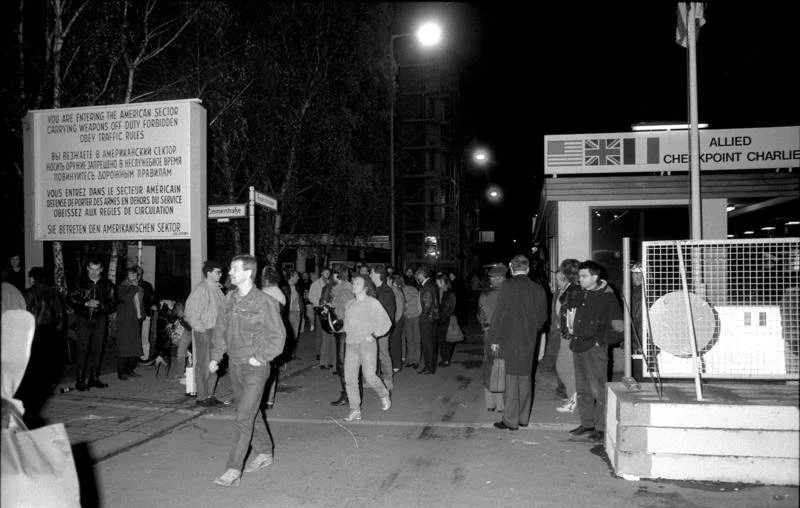
Bundesarchiv, Bild 183-1989-1110-018 / Oberst, Klaus / CC-BY-SA 3.0, CC BY-SA 3.0 DE
From the quantum perspective, time does not matter. Bravo, Spotify! I do feel 27. There are days when I feel a bit older, but certainly no older than 35. So, how old am I? You do the math. I read once about an intriguing question that one could ask: when you talk to yourself—the inner dialogue that we all engage with—what is your age? How old are you when you address yourself? Try it.
For me, it is still the same "I," the same being that experienced the hot sand on the beach, the taste of the bread that my grandmother gave me, the first kiss. Yes, the body changes, but what's on the inside does not. Or does it? A part of the Hermetic Teachings addresses Mental Gender - the consciousness regarding the Self. On close examination, we find that there is an "I" and there is "me." The mental twins. "Me" is composed of feelings, tastes, likes, dislikes and habits that create a personality. It is a creative force - knowledge and experiences gathered, however, "me" can change. It evolves, it powers the creative force, often considered as the "mental womb," capable of generating mental offspring. "Me" is feminine in nature, corresponding to the subconscious mind. A mind that is becoming. On the other side, there is "I," representing the aspect of being. It is the driving force, masculine energy able to stand aside and witness the mental creation that "me" puts forward. This part connects to the conscious mind, and it remains unchanged. The two are similar in kind but very different in degree - "As above, so below; as below so above."
In early September last year, I wrote a post titled Do not fear what awaits around the corner, which received a nice number of impressions, given its focus on human consciousness. I am not sure how LinkedIn calculates statistics, but seeing over 60,000 impressions was not bad at all. Why am I posting on this subject in the Design Thinking Group? What is the connection, if any? I believe there is a substantial connection between design, or rather, a creative process and the state of consciousness. Let's play this game again and, just for fun, see if we can explore another possibility. Shall we?
How about turning accepted views upside down? What if the consciousness is not produced by the brain and confined inside the skull, but is a pervasive, fundamental aspect of reality that the brain merely accesses or "tunes into." This theory is called the nonlocal consciousness. In this view, the brain is a sophisticated filter rather than the source - part of a deeper, nonlocal "implicate order" or holographic field, with each mind being a local expression or fragment of this larger whole. The quantum field, the field of unlimited potential, the Ether or whatever we want to call it, is where everything already exists. When we shift our focus from what we know (the particles, the physical reality) to the unknown (the wave, the possibility), we suddenly change the settings on our filter (the brain), tuning into a very different type of "music." Instead of solving a design challenge, we remember the solution. Everything already exists. All it takes is the right focus.
Sounds crazy, but from this angle, many unexplained yet well-documented phenomena, like near-death experience, suddenly make total sense. As for the unified field, or quantum field, it exists. I use it every day. Apart from design, I am a Certified Energy Healer, working remotely with people near and far. Does it work? Yes, it does. How can I connect with someone 10,000 km away? I use the field. It is like tuning into a specific energetic signature, and it is instantaneous—no delay, no lagging, and no dropped connections, the WiFi style. Ask and receive—a standard process used by thousands of practitioners every day.
I started asking myself, how can I apply this experience to the design projects I work on? Let's start with the Autonomic Nervous System, organized into the Sympathetic Nervous System, responsible for the Fight, Flight or Freeze response, and the Parasympathetic Nervous System, which covers the Rest, Digest and Repair portion that the subconscious mind uses to maintain the body's optimal state. It is either-or. We can't be in both the Sympathetic and Parasympathetic dominance. When we are in the Sympathetic dominance—Fight, Flight or Freeze—being creative is challenging. Imagination suffers when we can't relax. How to relax? The best way is through breathing. There are tons of tutorials and books on this topic, starting with Breath by James Nestor.
From a design thinking perspective, the connection to nonlocal consciousness theory becomes intriguing. While no direct scientific link exists between Design Thinking and nonlocal consciousness, you can build a coherent bridge by viewing both as ways to engage a broader "field of potentials" that goes beyond linear, rational thought. This theory can meaningfully inform how designers understand and practice their process.
Cognitive neuroscience frames design or creativity as a coordinated activity across brain networks—the prefrontal and medial temporal regions—that support imagery, memory, analogy, and evaluation. However, the core skill lies in oscillating fluidly between generative modes (producing ideas) and evaluative modes (selecting them), rather than just generating more ideas or critiquing harder. Even in this view, consciousness remains central as the space where ideas are conceived, combined, and refined.
If you accept nonlocal consciousness—even provisionally, just for the sake of this exercise—several bridges to design appear:
Field of potentials: Nonlocal or Omni-local consciousness is described as containing "universal potentials" that become explicit as forms and images. A designer might experience sudden, cross-domain insights—as if "pulled" from a wider field of meaning—rather than constructed step by step.
Intuition as nonlocal access: Studies and models of "nonlocal intuition" propose that a calm, coherent state (often heart-focused, emotionally positive) may increase access to information not explainable by standard cues, which some entrepreneurs use in decision design. In practice, designers talk about "gut feelings" about which concept will work, beyond available data.
Transpersonal or shared creativity: Phenomenological work on creativity sometimes describes moments where groups feel they are "thinking together" in a way that transcends individual boundaries, a kind of shared mind during co-creation. A nonlocal view interprets this as multiple local minds briefly accessing or expressing one larger process.
Conscious intention as selector: Some theories see consciousness as actively selecting which possibilities become real from a broader set of quantum or imaginative options. In design, focused intention and attention would then be the mechanisms by which the designer "collapses" many potential solutions (the wave) into one realized design (the particle). The double-slit experiment comes to mind.
Even if you stay agnostic about the ontology, nonlocal consciousness offers useful practices and attitudes:
Cultivating receptive states (meditation, coherent breathing, quiet reflection) to allow ideas to "arrive" rather than be forced, in line with work on altered states and enhanced creativity.
Treating intuition, sudden insight, and cross-domain triggers as legitimate signals in the design process, not noise, while still testing them rigorously in the local world.
Viewing design as collaboration with a larger field of meaning—social, cultural, perhaps transpersonal—so that you listen not only to client constraints and personal taste, but to what "wants to emerge" in a context.
A nonlocal consciousness theory may reframe design from a purely individual, brain-bound problem-solving activity into an intentional dialogue with a wider, interconnected field of meaning and potential, thereby changing both how we design and how we interpret our own creative experiences. Fascinating, isn't it? While it uproots everything considered the truth, something is comforting in the idea that "me vs. you," "us vs. them," the separation, is just an illusion, albeit a very persistent one, as the guy with the iconic, unruly hair would say.
Another longer article touching on consciousness, creativity and time, which, at least from Spotify's perspective, allows us to revisit the past.