Finding Balance between Left and Right
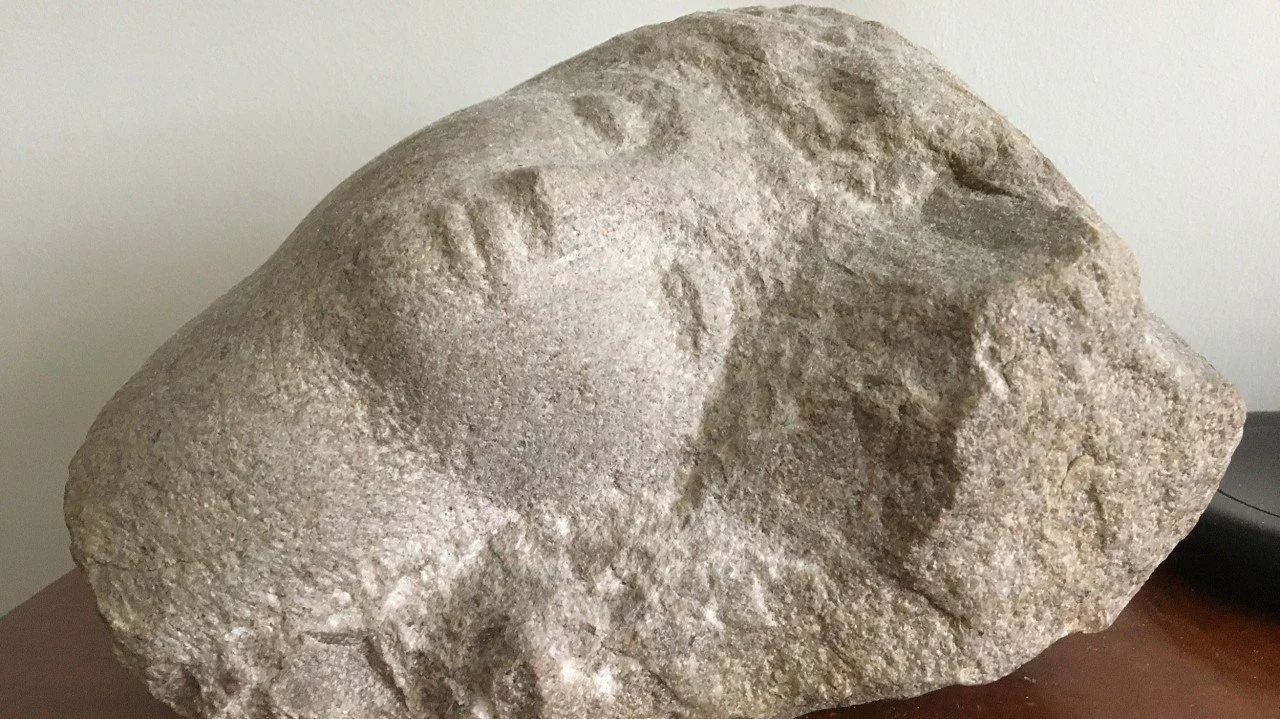
Stanislaw Horno-Poplawski, "Dream", granite. Photo: Gregory Ronczewski
Originally published on LinkedIn in October 2025.
Preparing a canvas is a messy, two-day job. Assuming the stretcher, or frame, is straight, sanded, and not twisted, the next step is to cut the fabric to size and staple it in place. When I started preparing canvases for my wife and me, I didn't have a staple gun, so it was a rather painful process, with my left-hand fingers suffering the most. However, with the gun, it goes much faster. Logic suggests stretching the fabric immediately in a strong fashion, but that's not the right approach. With stapling done, spreading the glue begins. Preparing it is a whole different story. The glue is spread evenly with a wide spatula, filling in the tiny holes in the fabric. It has to be lukewarm - not too cold, though, as it will not spread at all. It is the drying glue that stretches the fabric, so if it were already strongly stretched, it may cause the joints of the wooden frame to crack. The glue needs to dry, usually overnight. The final step is to apply gesso, or primer, depending on whether it's for acrylics or oil paints. In any case, after all this work, there is a beautiful, white and empty canvas in front of you.
A mix of joy and anxiety always accompanied me when I stood in front of an empty canvas - an excellent metaphor for anything, creative or not, that awaits: a space where all possibilities can materialize. Like a particle in its superposition before it is observed - a quantum moment, so to speak.
Joy and anxiety.
Creativity, imagination, and a love of unknown exploration on one side, while anxiety, fear of failure, logic, and rationality keep the creative wings from spreading. Yin and Yang. The left and right hemispheres of the brain.
Left and right.
There is a passage in the bible where Jesus instructs the fishermen to cast their net on the right side of the boat to catch a great multitude of fish after a night of fruitless effort from casting the net off the left side of the boat.
"He said to them, 'Cast the net on the right side of the boat, and you will find some.' So they cast it there, and they were unable to haul it in because of the great number of fish."
~ John 21:6
Is it metaphorical or literal? Perhaps, it's both? It's about trust and surrender to a greater power, but it's also about rational thinking, calculation, and being fully immersed in the physical world—the left hemisphere. Or, letting go, being relaxed and in the flow—the right hemisphere. Rick Rubin beautifully writes about this in The Creative Act: A Way of Being.
"Turning something from an idea / into a reality / can make it seem smaller. / It changes from unearthly to earthly. The imagination has no limits. / The physical world does. / The work exists in both."
~ Rick Rubin, The Creative Act: A Way of Being
What is it that makes being in the flow so magical? Is it magical? Or, it's a natural creative state we all share. There are moments when time seems to stand still—no past or future - just the present moment unfolding in front of us. It is consciousness that makes each moment so special. Federico Faggin, whom I mentioned in my previous post, said: "Consciousness is vaster than space and time." Max Planck declared: "I regard consciousness as fundamental. I regard matter and derivative from consciousness. We cannot go behind consciousness. Everything that we talk about, everything that we regard as existing, postulates consciousness."
Consciousness and subconsciousness.
Recent studies suggest that we consciously use less than 1% of the brain's power. The rest—99%— belongs to the subconscious. Let's compare the two.
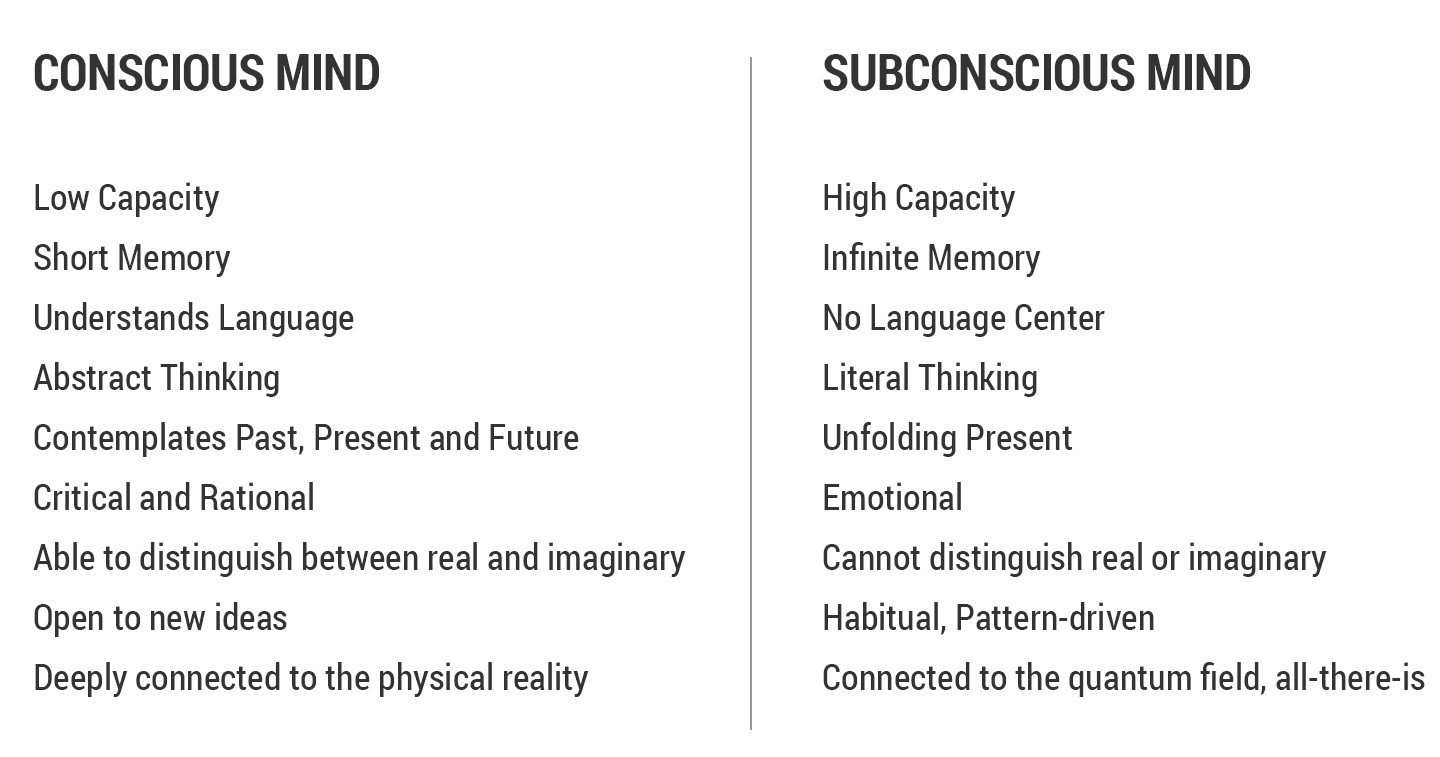
For the subconscious, apart from its high capacity and infinite memory, the most profound power, in my opinion, lies in being connected to the shared consciousness—a quantum field of unlimited potential. Of course, it is a concept, a very compelling theory. Obviously, analyzing, rationalizing, and criticizing, which are processed by the left side of the brain, are all critical and essential for our existence. But, for an artist, a designer or anyone, for that matter, the intuition and inspiration to see something that is not there yet is all that matters. When I was a kid, it puzzled me how my grandfather (he was a sculptor) looked at an ordinary stone on the side of the road and saw a woman's face, which he would later bring to life with his chisel. The finished sculpture had to exist in the field of unlimited potentials - he just tuned in to retrieve it. Reflecting on our endless conversations, visits to his studio, his incredible energy, he was—most of the time—relaxed, easy-going, and stress-free. Perhaps it was my perception, but that's how I remember him.
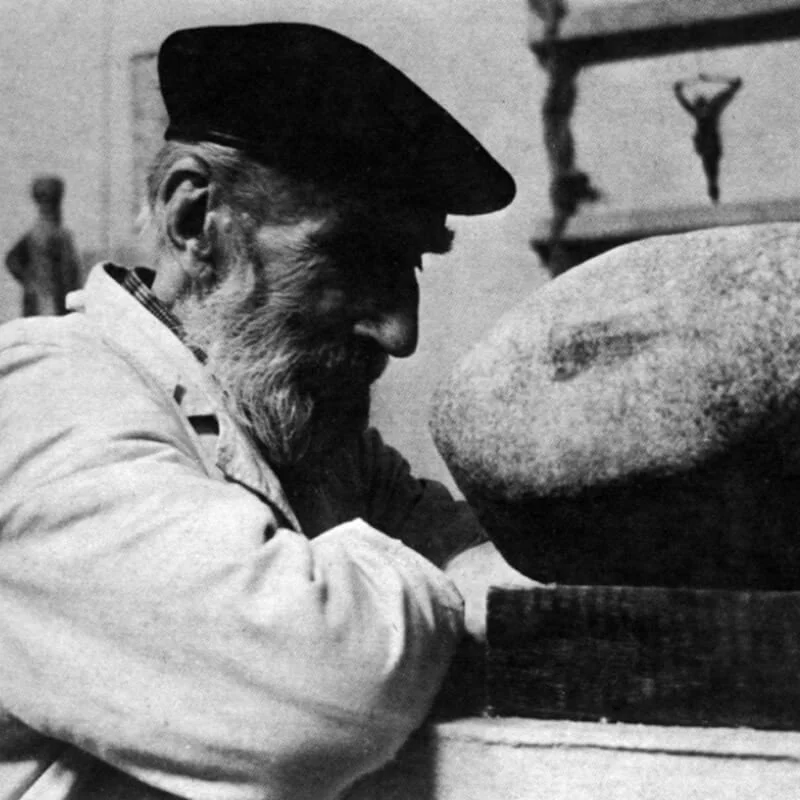
My grandfather, Stanislaw Horno-Poplawski, 1980s. Photo: Sergo Kuruliszwili
There is another twist in the left-or-right story: the sympathetic and parasympathetic nervous systems - fight, flight, or freeze vs. rest, digest, and repair. It's either or. You can't be in two systems at the same time. And here is what makes it even more intriguing: when the body is predominantly set in the sympathetic nervous system, creativity and inspiration are very difficult to sustain. Simply, there are more important things to do - fight, flight, or freeze. It's not about creating - it's about staying alive - calculating the odds, and rationalizing (the left side of the brain). When I am stressed, the work, especially the creative part, is always a struggle. I learned that it is much better to go for a walk, look at the sunset, and listen to music instead of being frustrated with a project that isn't going well. Do what my grandfather did, relax, and ideas will start flying like crazy.
There is another way to achieve a relaxed state: releasing trapped negative emotions and emotional baggage accumulated over the years that keeps draining our energy supplies. The released negative energy makes room for positive emotions. So simple and yet invisible.
Working with the subconscious mind is truly amazing. Using muscle testing (a form of biofeedback), one can navigate an elaborate, multidimensional set of data which is constantly changing. Forming the right question, or a prompt, is not that important - the subconscious (when working with a client, or on yourself) will not pay attention to the words, because there is no language center in the subconscious mind. Intention is all that matters. That is why energy healers, like myself, can work with animals. If you are interested in embarking on a healing journey with me as your interpreter and guide, book a session, and you will gain a genuine appreciation of your subconscious mind.